Richard Pearce
1950-2018
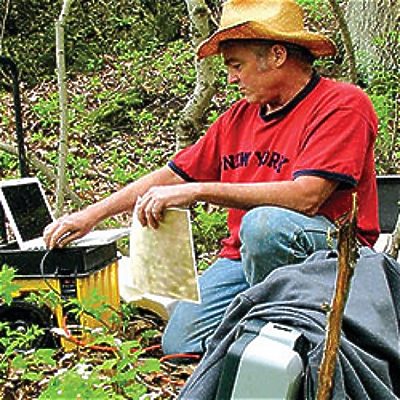
The last 16 years of Richard Pearce's life, he spent trekking through woods, prairies, and along waterways throughout Illinois, Iowa and Wisconsin. He spent countless hours perfecting his photo-scanning technique, capturing high-resolution images of plants and, occasionally, a close-up, slow-motion video of the insects that would visit them. Richard was not a botanist or photographer by trade; in fact, he held a PhD in Cell Biology from the University of California at Santa Barbara. After receiving his PhD, he went on to lead research in the early 1980s linking the HIV virus to AIDS. His requests to publicize the transmission of the epidemic subsequently led to a large-scale awareness campaign. His research on its spread helped decrease fatalities worldwide. He moved to diabetes research with a focus on immunology during the 1990s. Upon retirement, Richard moved to Galena, Illinois, in 2001. It is believed that Richard is the first person to experiment with and perfect the art of photo-scanning plants. Taking a laptop computer, office scanner, power pack, and extra lights in the field, Richard was able to produce incredible images with uniform high resolution from edge to edge. He was methodical with his work and very particular about timing the capture of a bloom at the most opportune time. He finished a total of 358 wildflower species. As his artistic talent developed, he used videography to publish DVDs on entomology and botany. He published his first scientific paper, "Great Lakes Botanists" in December 2017.
The last 16 years of Richard Pearce's life, he spent trekking through woods, prairies, and along waterways throughout Illinois, Iowa and Wisconsin. He spent countless hours perfecting his photo-scanning technique, capturing high-resolution images of plants and, occasionally, a close-up, slow-motion video of the insects that would visit them. Richard was not a botanist or photographer by trade; in fact, he held a PhD in Cell Biology from the University of California at Santa Barbara. After receiving his PhD, he went on to lead research in the early 1980s linking the HIV virus to AIDS. His requests to publicize the transmission of the epidemic subsequently led to a large-scale awareness campaign. His research on its spread helped decrease fatalities worldwide. He moved to diabetes research with a focus on immunology during the 1990s. Upon retirement, Richard moved to Galena, Illinois, in 2001. It is believed that Richard is the first person to experiment with and perfect the art of photo-scanning plants. Taking a laptop computer, office scanner, power pack, and extra lights in the field, Richard was able to produce incredible images with uniform high resolution from edge to edge. He was methodical with his work and very particular about timing the capture of a bloom at the most opportune time. He finished a total of 358 wildflower species. As his artistic talent developed, he used videography to publish DVDs on entomology and botany. He published his first scientific paper, "Great Lakes Botanists" in December 2017.